I was thirty-five when I wrote this account. I had cycled throughout childhood, then left my last bicycle in a student friend’s garage about fifteen years earlier. Considering an electric bike for everyday use made me want to start again, in a neighbourhood whose hills had repeatedly put me off.
Choosing an electric bike for everyday use
I had been living for a year in a more rural neighbourhood. I liked the idea of cycling again, but every refreshing descent seemed to lead to another punishing climb. There were enough hills for the idea to keep slipping to the bottom of the list.
A conversation with a friend who rode an electric bike changed things. I began looking into motors, batteries and conversion kits. At first it was mostly curiosity: I assumed the investment would be too large.
What my conversion cost at the time
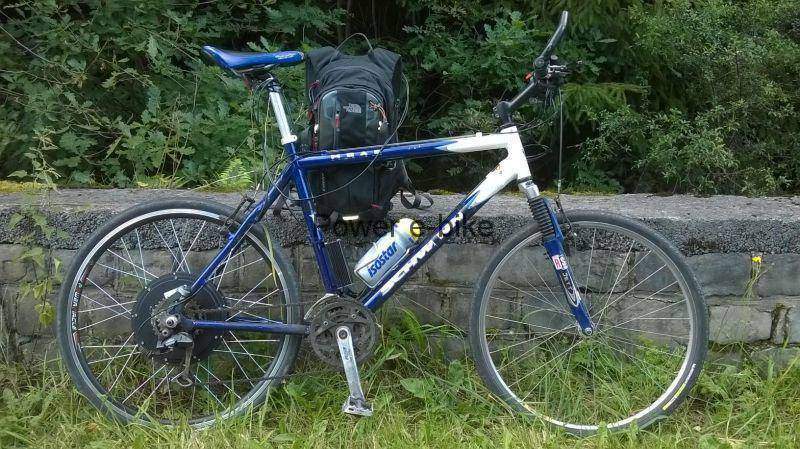
I discovered that converting a bicycle could be an alternative to buying a complete machine. I was not preparing for the Roc d’Azur event, so I chose a hybrid bike costing €350. I added a conversion kit with a 60 V battery, bought for €833 through a group purchase at Power E-Bike.
Those are the historical amounts for my purchase. They do not describe current prices or a conversion suitable for every bicycle. The configuration in this account cannot establish whether different components are compatible.
Getting started was not straightforward
I was not particularly handy. Fitting the parts was one thing; getting the whole arrangement to work was another. At first the battery was not supplying energy to the motor. After a fairly primal shout, I contacted the customer support available at the time and received patient help.
Getting going was therefore difficult in more than one sense. That belongs in the story too: enjoying the finished bicycle does not mean the installation was instant or obvious to a beginner.
First rides and the range I actually experienced
The response surprised me when I pressed the throttle. The equipment was advertised with a range of “up to 50 km”. I did not verify that limit. My rides of 25–30 km went well and made arriving at work without as much sweating more practical.
I also described riding uphill for five or six kilometres without pedalling. That records the behaviour of my old throttle-equipped conversion; it is neither a riding recommendation nor evidence that the machine met road-legal pedal-assist requirements. The sensations and distances relate to this individual experience.
Parking, charging and my seven-month assessment
Avoiding rush-hour car difficulties was the change I appreciated most. I could also leave the bicycle in the entrance hall at work, something I could not do with a car or scooter.
At the time I felt that cold weather reduced range quickly and said I charged between uses. I questioned whether I was charging too often. This account therefore does not establish a maintenance method: the instructions for the particular battery remain the reference.
After seven months of regular use, I was still happy with my battery. That was the extent of my experience, not a forecast of its eventual lifespan. Calling the electric bike the “brilliant idea of the year” was an enthusiastic verdict from my thighs and calves.
Guides to understanding the components
- E-bike kit batteries: understand the main parameters
- Conversion kits: choice, installation and compatibility