
The battery of an electrically assisted bike (EAB) in a few lines
07/10/2026My first e-MTB ride
07/10/2026
This guide revisits an older technical example. The pictures, kits and options are historical; they do not establish current availability or compatibility with your equipment.
Choosing a battery for a Power E-Bike kit
The starting question is which battery to pair with your kit. Distinguish voltage in volts (V), capacity in amp-hours (Ah) and maximum continuous discharge current in amps (A).
The original article used a rider producing roughly 150–300 W as a reference and compared the kit with eight riders. This illustration does not measure the actual mechanical power delivered to the wheel.
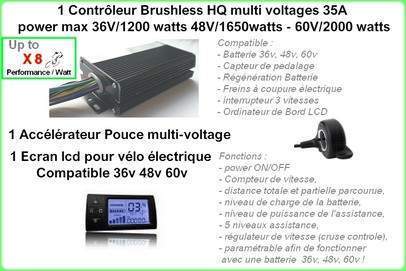
Power depends on the battery, controller limits, motor and operating conditions. The controller limits current; its label alone cannot guarantee power or range.

The older 35 TLCD and 35 HLCD packs used a controller advertised at 35 A; the article associated the latter with a twist throttle. These names do not establish that those options remain available.
The historical power examples
The article quoted approximately 1,200 W at 36 V, 1,650 W at 48 V and 2,000 W at nominal 60 V. These are historical estimates, not certified continuous mechanical power ratings.
At a battery current of 35 A, V × A gives 1,260 W at 36 V, 1,680 W at 48 V and 2,100 W at 60 V: theoretical electrical input power. Actual voltage, limits and losses change the result.
A kit does not automatically accept 36, 48 and 60 V. Check controller and motor voltage limits, the fully charged battery voltage, BMS, connectors and compatible charger. Nominal voltage alone does not establish compatibility.
Continuous current, peak current and capacity
If the example controller can actually draw 35 A from the battery, the battery and its BMS must permit that continuous discharge current. Check whether a rating refers to battery current or motor phase current: these are different values.
A capacity of 10, 15 or 20 Ah does not by itself determine allowable current. Peak current is available only for the manufacturer’s specified duration. The 20–120 seconds mentioned in the old article are not a universal rule.
Three batteries pictured in the old article
60 V / 15 Ah example
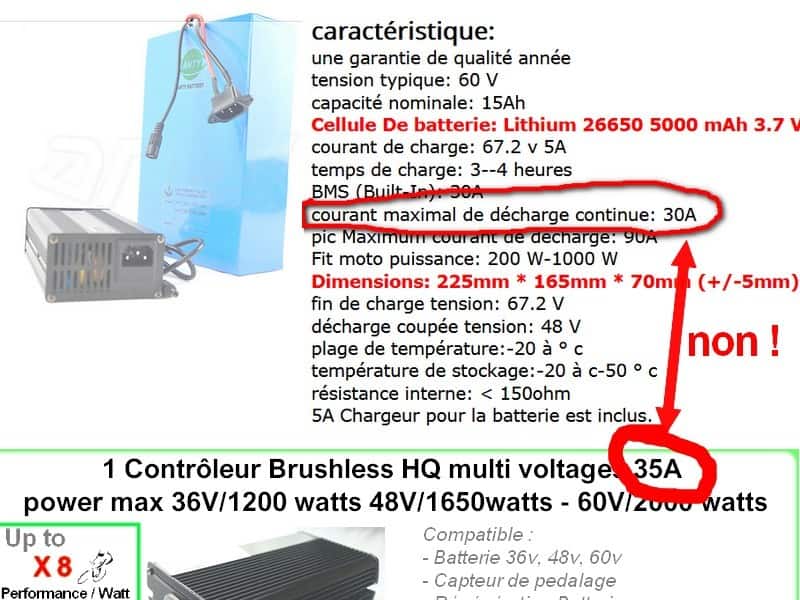
The author advised against this battery with the 35 A controller and considered it for 17 A or 22 A. Check the continuous discharge rating of the exact model; 15 Ah alone supports none of those conclusions.
60 V / 10 Ah example
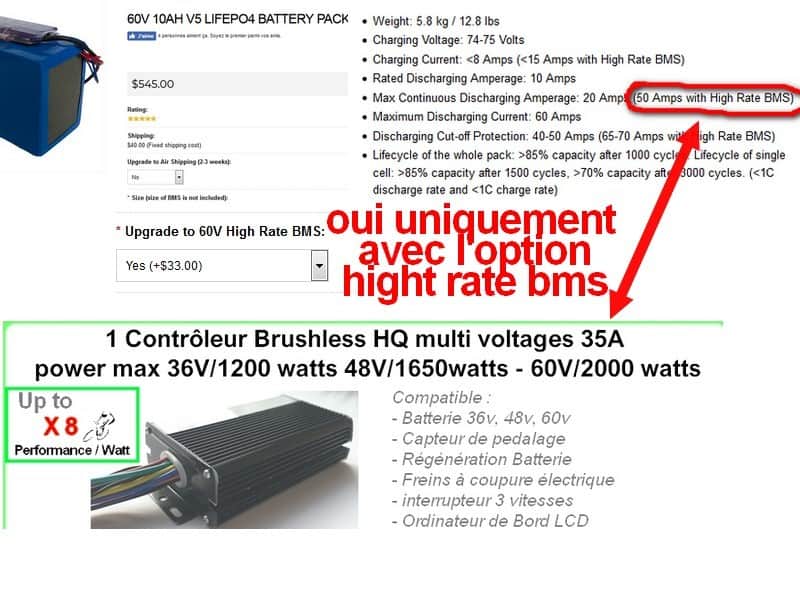
The old example mentioned an “upgrade high Rate” option advertised at a continuous 50 A. It would meet a 35 A demand only if that rating, the BMS and full compatibility are confirmed by the model’s documentation. The reported range of about 20 km was an estimate, not a guarantee.
60 V / 20 Ah example
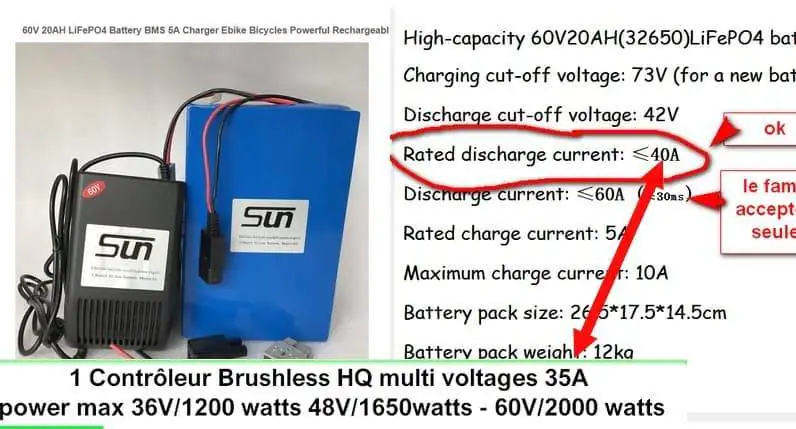
The screenshot stated 40 A “Rated discharge current”, above the example’s 35 A. This meets only the current requirement if the specification is genuine and applicable; it does not establish full electrical compatibility.
Charging, use and regulations
Use the charger specified for the battery and follow its manual, temperature limits and charging conditions. A damaged battery needs advice from the manufacturer or a professional. A high-power conversion kit is not automatically road legal as a pedal-assist bicycle: check the complete vehicle’s conformity and applicable French rules.