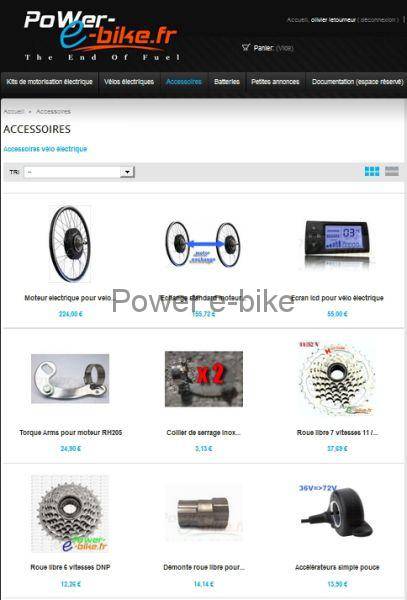
Choosing electric bike accessories starts with the complete installation, rather than a familiar-looking plug or photograph. This page preserves the historical Power E-Bike selection and explains how to interpret its references. It is a documentary archive: the former sales descriptions do not establish current availability, an active sales offer or independently verified performance.
Electric bike accessories: establish the requirement
First identify the actual requirement. An unreadable display, a worn freewheel and a failed electronic component call for different checks. Record the references printed on the motor, controller, display and battery. Keep photographs of the labels so that similar-looking versions do not get confused.
The electric motor selection guide helps distinguish different installations. An identified component gives you a starting point for finding the right documentation; its model name alone cannot establish that the complete bicycle is suitable.
RH205S references and historical figures
The table reproduces only the speeds associated with RH205S variants in the old text. That text did not document test conditions, load, actual wheel diameter or measurement method. These are not measurements made here and should not be treated as a reliable performance comparison.
| Historical reference | Advertised speed, unverified |
|---|---|
| RH205S-180/280 | 35 km/h |
| RH205S-230/320 | 41 km/h |
| RH205S-280/380 | 48 km/h |
| RH205S-330/420 | 54 km/h |
| RH205S-350/480 | 58 km/h |
The former description also mentioned “26P/28P” wheels, 24–72 V batteries or higher voltages, and 2,000 W. Those unverified historical claims do not define a safe operating range. An exchange between “6×10” and “10×6” windings was mentioned too, without establishing that every motor could accept the change.
Battery and controller: check the whole system
Matching nominal voltage is insufficient. Compare the battery’s fully charged voltage with the controller’s documented maximum, then check each component’s current limits. Connectors, pin assignments and protections must match the instructions for the exact version. Do not infer a pin assignment from a wire colour or the shape of a housing.
The motor must also work with that controller: identification, any sensors and thermal limits all matter. If compatible documentation cannot be found, record compatibility as unknown rather than making an experimental connection.
LCD and PAS: identify the correct interfaces
An LCD can display information and communicate settings. However, a dedicated socket and matching connector do not establish the communication protocol or correct supply voltage. Identify the complete display-controller pairing before looking for a replacement, including version information where available.
A PAS sensor detects pedalling according to its design; it does not automatically balance motor power against cadence. The sensor type and controller’s response determine operation. A thumb throttle does not replace these checks and may change the vehicle’s permitted use. Keep the control behaviour separate from claims about motor capability.
Torque arms and regeneration: assess the loads
A torque arm reacts some of the axle forces from a hub motor. Installing one does not make every fork or frame suitable. Axle shape, contact surfaces and the bicycle’s material must be considered together. An unsuitable arm cannot be assumed to retain the axle securely.
Regenerative braking is not enabled simply by adding an arm. The motor, controller, battery and battery management must support it in the actual configuration. Leave it disabled when the documentation does not explicitly confirm support for the complete system.
Small parts also require mechanical checks
Historical lists included six- and seven-speed freewheels, an extractor, brake levers, grips, switches and three-position selectors. Check attachment and available clearance before treating parts as interchangeable. An extraction tool must match the particular freewheel, rather than just its number of speeds.
Also inspect the drivetrain, brakes and frame condition. French consumer authority DGCCRF notes that a converted bicycle still needs appropriate frame strength and braking performance. A new electrical accessory does not repair an existing mechanical weakness or establish that a bicycle is ready to ride.
Advertised speed and road use
In France, an ordinary assisted bicycle requires pedalling, continuous rated motor power no greater than 250 W and assistance stopping at 25 km/h or when pedalling stops: Service Public.
Historical catalogue figures provide no road-use certification. A displayed limit or product name cannot establish the classification of a complete installation. For another country, check the rules applicable to that vehicle locally.
Create a compatibility record before replacement
Keep component references, matching manuals, electrical limits and mechanical checks in one record. Mark each proposed pairing as documented, incompatible or unknown. This prevents an assumption about one accessory becoming an unsupported conclusion about the entire bicycle.
The 9C installation account adds the reservations encountered in one particular build. It is an example, rather than a universal approval. For the safety of conversion kits, also consult the DGCCRF guidance.