

The battery for your Power-e-bike electric bike kit, for dummies
07/10/2026Retirement on an electric bike
07/10/2026
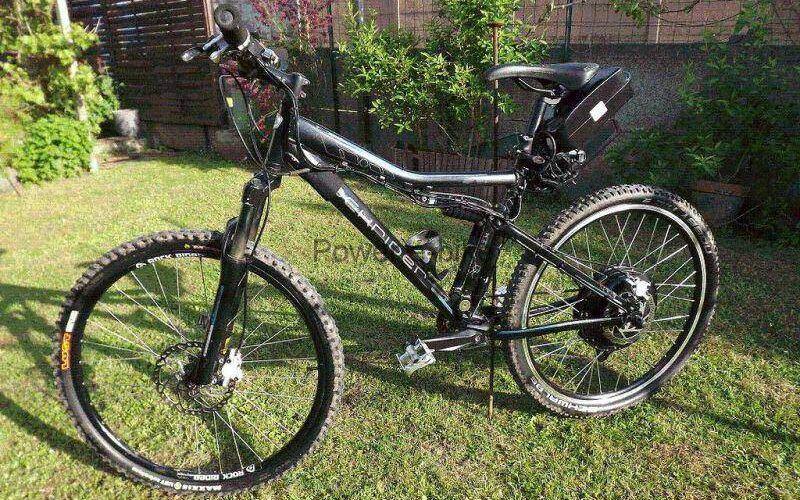
The first part of my article dealt with the actual fitting of my e-MTB kit on my Rockrider 6.3.
In this second post, I share my fresh impressions after my first MTB ride at the handlebar of my new electric bike.
Before the ride planned for the weekend, and the PAS sensor fitting problem solved as described earlier, a small outing is in order
with the steed to check the bike’s capabilities before heading out into Mother Nature’s lands.
Heading to the woods near my home where I usually train. I deliberately choose the most demanding passages, the ones that used to force me to “push guts” or put a foot down (steep short climbs, taluses in the undergrowth, long climbs or muddy-as-you-want sections,…). And there… I am no longer “me” but a young sprightly mountain biker with sharpened quads… everything passes!
Not one foot down along the 25 km during which I took great pleasure in chaining all the crossings that used to put me off until then.
On these very good impressions, back home, cleaning of the e-MTB and general check of the installed components:
nothing to report… everything is spotless.
Day D: Ride in the Collines region, already done the previous 2 years, so a good before/after comparative test…
The repeated recent rains let one fear a muddy ground in the wooded areas… we will see.
Given the local relief, I previously settled for a modest 30 km out of the 3 courses offered (30 km – 50 km – 70 km).
This time, hang parsimony! Go for the 50 km (a way to test the range of my battery of 36V 10 Ah without risking having to pedal “dry” the last 10 km of the ride due to a “power cut”…
The weather this morning is mild and rather sunny… contrary to habit, I delay my start on the 50 km to 8:30am instead of 7, a way to let pass ahead of me a few pelotons of sharp club mountain bikers, with the secret hope of finally being able to tease them with the help of my “new assistant”!
I fixed my LCD screen on the left against the grip (I removed the left shifter of the front derailleur since I am on a 30 NW single chainring), the left thumb lets me, without letting go of the handlebar, juggle with the “+” and “-” of the assistance level control: it is perfect.
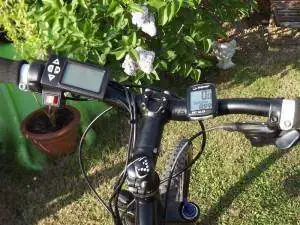
Throughout this course, I will navigate between level 3 and 5 of the assistance, depending on the difficulties.
Very practical on the display, the display of the instantaneous power level delivered by the RH205 motor, which allows proper dosing of the use of the onboard electrical resource.

The PAS works wonders and “sends” always without brutality after a short latency time one gets used to very quickly and which one therefore anticipates when the difficulty looms ahead.
 The noise of the motor is barely audible (no gears or other mechanics likely to clatter… appreciable and discreet).
A first climb slippery in the undergrowth, zigzagging between birches: last year, here, it was on foot, bike pushed to the top.
Today, change of register: I go into 4, I climb back 2 sprockets, and off we go….I make my way between my colleagues and literally swallow the obstacle: that, is done!
Reassured about my new abilities, I continue my journey with certain pleasure and renewed confidence.
The steep short climbs alternate with long sometimes jarring descents and pretty singles sometimes muddy: all is well and the heart no longer sees red although I decided not to give in to ease and to stay in substantial physical effort.
My opinion: the e-MTB must help me but it is up to me to “do the job” and on this, the electric assistance, if it frees the mountain biker from a good part of the muscular and cardio-vascular hardness, in exchange dedicates him a rewarding new priority task: “riding”!
Indeed, the question is no longer “Will I be able to climb this climbing and winding 50 m trail?” but becomes “Where and how will I place my front wheel to slip as best as possible in a clean line, between the stones and roots that present very quickly under my tyres?”.
On the downhill sections (straight or technical), the assistance switches off of course and the weight of the electric bike recentered towards the rear ensures good steering, standing on the 2 pedals horizontally, without excessive rebounds. There, as I am cautious by nature and do not want to offer myself the fall of the year, I willingly let pass the young daredevils avid of full-throttle descents….but at the bottom of each descent…there is a climb…and there, grandpa does not sulk his pleasure and climbs back one by one his companions sometimes crimson-faced by the effort to be provided….
40 km of pure pleasure already show on the counter: 10 remain and 2 to 3 bars on the battery gauge…careful… will have to manage that finely to avoid the ultimate humiliation, after this beautiful course, of coming back to the paddock with the electric fairy absent!
So, I am very attentive to the chosen level of assistance and reduce it as soon as my legs rather spared are able to ensure the propulsion alone.
It pays because there are now 5 small km and 1 bar left on the gauge: letu0027s be crazy, feeling the stable close, I put one more layer, a way to “check out” a few competitors at the limits of their quads at this end of course: final rush for the fun and arrival “in good condition”.
The battery now shows “0 bar” and therefore allowed me to complete the 52 exact km of the circuit (500 m of elevation gain +) with assistance often between 3 and 5 (apart from descents of course) for a 10 Ah, I think this range is correct (bike + rider: 100 kg).
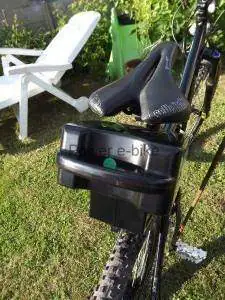

In conclusion, this bike allowed me, thanks to the installed kit, to discover a new dimension to my riding, until then quite inaccessible to my eyes and reserved for fit young people with good technical level.
For me, the e-MTB is not a “cheater” or “lazy person” bike but indeed a bike that provides physical activity well in adequacy with the age, state of health and technical level of its rider and for that I say loud and clear “contract fulfilled!”. Well done the RH 205..