
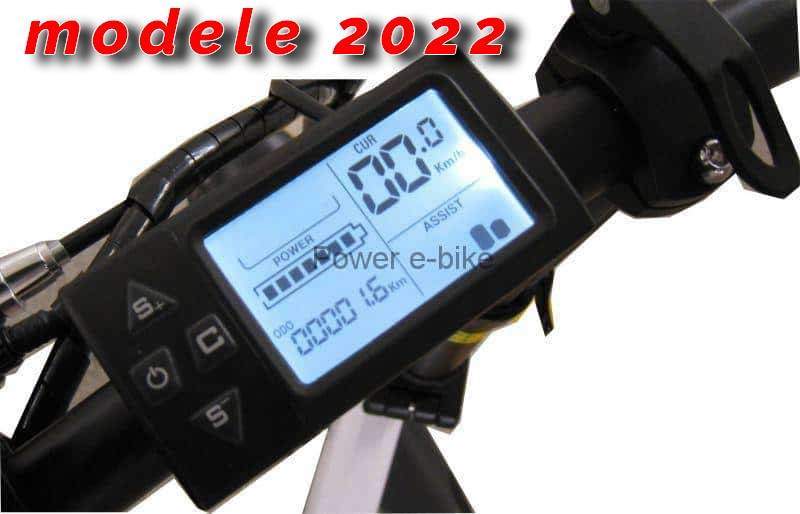
Description
LCD V3 861 display manual
This guide concerns models shipped since August 2022. It covers the LCD 861 functions, wiring and settings. The original illustrations and document are retained to identify the buttons and screen areas.
Download the original English manual (PDF)
Hardware versions, display firmware and the controller can change the available functions. The manufacturer notes that product updates may introduce differences. Check the version, voltage and connector before connecting the display or changing settings. Shop-specific information is identified below.
Voltage, communication and wiring
The shop specification lists 24V or 36V DC operation, selected on the display, with versions adapted for 48V, 52V or 60V according to the request and hardware. A menu setting does not change the hardware version: support for all these voltages cannot be guaranteed on every unit.
Communication: UART. The listed extended functions are voltage/PWM assistance-level control and an independent external speed sensor. Controls include power, front lighting, 6 km/h walk assistance and cruise control. Their operation depends on the controller and its software.
The sources show two wire assignments. The shop page and the PDF use different colours for lighting and communication. The following tables describe those variants; they are not a universal pinout. Do not combine them or connect wires by colour alone. Confirm the assignment for your connector.
Assignment described on the shop page
| Wire | Function |
|---|---|
| Red (D+) | Power positive |
| Black (GND) | Power negative |
| Blue (DS) | Controller power-on control (called “electric door lock” in the manual) |
| Brown (DD+) | Lighting-control positive; see the qualification below |
| Green (RX) | Communication receive |
| Yellow (TX) | Communication transmit |
| White (GND) | Lighting-control negative |
Assignment described in the 861-A PDF
| Wire | Function |
|---|---|
| Red (D+) | Power positive |
| Black (GND) | Power negative |
| Blue (DS) | Controller power-on control (called “electric door lock” in the manual) |
| Yellow (DD+) | Lighting-control positive; see the qualification below |
| Green (DAT) | Communication receive |
| White (TX) | Communication transmit |
For DD+, the original text states that the wire may be left unconnected when controller hardware and software handle lighting. This statement is version-dependent and must be checked before wiring.
Reading the screen
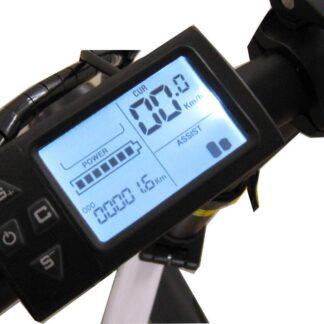
The manual shows all screen segments during the initial one-second illumination. This illustration combines indicators that may not all be available on your installation.
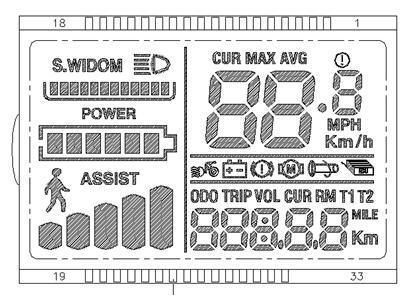
| Area | Indication |
|---|---|
| Lighting | Headlight symbol when the function is active. |
| Current | Current-level bar: requires controller-software support. |
| Battery / POWER | Battery voltage level. |
| Multifunction area | ODO: total distance; TRIP: trip distance; VOL/VOLT: voltage; CUR/CURRENT: current; RMT/RM: remaining distance, only if supplied by battery-protection-board software; TIME: running time. T1/T2 segments appear in the illustration without a separate explanation. |
| Speed | CUR: current speed; MAX: maximum; AVG: average. Units: km/h or MPH. |
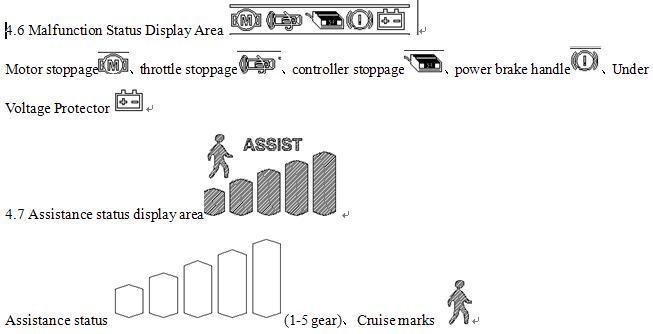
| Status / faults | Indicators for motor, throttle or controller stoppage/fault, motor-cutoff brake-lever operation and undervoltage protection. The manual describes symbols, without a numerical error-code table. |
| ASSIST / assistance | Assistance levels 1–5. The walking-person symbol is shown as a walk/cruise-mode marker. |
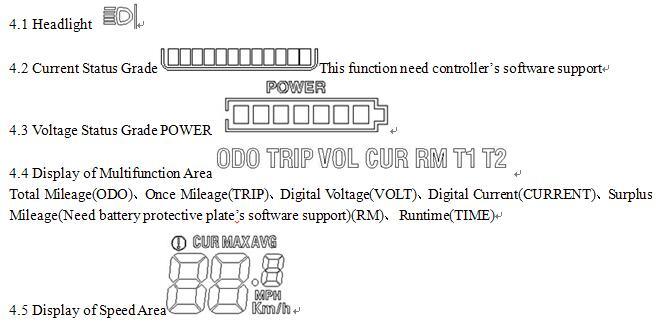
Speed can come from four sources, depending on the installation: a directly received motor Hall signal; a motor Hall signal relayed by the controller; a slow Hall signal produced once per wheel revolution; or that slow signal relayed by the controller. Some configurations may combine sources. The manual expresses the Hall-signal period in 1 ms units. The display calculates speed from wheel diameter and the signal; motor Hall sensing requires the magnet count to be set.
Buttons and controls
The buttons are marked S+ (up), S− (down), power and CUR. The manual distinguishes a short press, a long press on one button and a long press on a combination. Short presses serve frequent operations; combinations are mainly used for settings. No short-press combination is described as a general control.
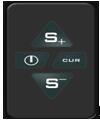
While riding, briefly pressing S+ or S− changes the assistance or electric level, depending on the mode.
 /

A short press on the power button cycles the multifunction-area data.

In assistance mode: short press on S+, level +1.

In assistance mode: short press on S−, level −1.

Hold S+ to change the speed display mode.

Shop-page addition: a long press on the illustrated button resets TRIP. This operation is not described in the supplied PDF; confirm it for your version.

With the bicycle stopped: hold CUR to activate 6 km/h mode (walk assistance).

With the bicycle moving: hold CUR to activate cruise control at the current speed. If cruise control is already active, the same command releases it.

Short press on CUR: turn lighting on or off, if supported by the controller.

Hold the power button: switch the display off if it is on, or on if it is off.

Short press on the power button: move to the next multifunction-area value (ODO, TRIP, voltage and other available data).

Accessing and saving settings
Hold S+ and S− together to open the settings menu. The manual names wheel diameter in inches, magnet count, LCD brightness and the undervoltage threshold as settings, then refers to P01–P14. It gives no separate procedure or value for that undervoltage threshold.
 +

In the menu, briefly press S+ or S− to increase or decrease the value. The modified value flashes.
 /

Briefly press CUR to save the current value: flashing stops.

The manual then specifies the S+ and S− combination to save settings and exit. It also specifies automatic saving and exit after 10 seconds without input. It does not identify a separate button for cycling parameter numbers; refer to the menu on your version.
 +

Parameters P01–P16
| Parameter | Function and values |
|---|---|
| P01 |
Backlight brightness: level 1 is darkest; level 3 is brightest. |
| P02 |
Distance unit: 0 = kilometres; 1 = miles. |
| P03 |
Nominal voltage: the PDF lists 24V, 36V and 48V, with 36V as default. The shop page adds 52V and 60V depending on hardware version. Select only the voltage matching the compatible display, controller and battery. |
| P04 |
Automatic sleep: 0 = no sleep; 1–60 = delay in minutes. |
| P05 |
Assistance-level count: 0 = 3 levels, with 1: 2V, 2: 3V, 3: 4V; 1 = 5 levels, with 1: 2V, 2: 2.5V, 3: 3V, 4: 3.5V, 5: 4V. These are the assistance-control voltages specified in the manual. |
| P06 |
Wheel diameter in inches; setting precision: 0.1 inch. |
| P07 |
Magnet count for speed measurement: 1–100. Power E-Bike addition for the RH205 kit: set to 46. This RH205 value is not in the manufacturer PDF. |
| P08 |
Speed-limit setting: 0–50 km/h; default 50. According to the manual, 50 means no limit from this setting. See the PWM and units note below. |
| P09 |
Start mode: 0 = start from standstill; 1 = start after moving. |
| P10 |
Drive mode: 0 = assistance, power determined by the level; 1 = electric mode; 2 = combined assistance and electric mode. The manual mentions an inactive control in modes 0 and 1, and an inactive electric standstill-start state in mode 2, without clearly defining them. Do not infer which button or control is disabled; confirm the version. |
| P11 |
Assistance sensitivity: range 1–24. |
| P12 |
Assistance starting intensity: range 0–5. |
| P13 |
Assistance-sensor magnet-disc type. The manufacturer text refers to three types and uses the unclear wording “5 Sherwin”, without a clear list or usable values. The magnet count and appropriate setting must be confirmed for your sensor. |
| P14 |
Controller current limit: default 12A; range 1–20A. Application depends on a compatible controller. |
| P15 |
Shop-page information: not implemented. This parameter is not described in the supplied PDF. |
| P16 |
Shop-page information: ODO reset. In P16, hold the illustrated button for 5 seconds to reset total distance. This operation is not described in the supplied PDF; confirm it for your version before resetting.
|

P08: the manual describes cutting PWM output above the set speed and restoring it when speed falls below the threshold; it then mentions current speed +1 km/h. That passage is imprecise and does not guarantee another controller’s behaviour. Speed-limit values are based on km/h. In mile mode, the speed display is converted, but the manufacturer warns that the P08 value shown in MPH may not match the actual display. Check operation on your version.
P10 and P13: the manufacturer’s wording is ambiguous. P10 does not reliably identify every control disabled in each mode. For button operation, use the instructions above. P13 refers to three magnet-disc types without a usable list. Confirm these settings with the shop, stating the controller and LCD version. P15 and P16, and TRIP reset, come from the shop page and may vary with firmware.
Reviews
There are no reviews yet.