Mid-drive motors: an alternative for the wealthy?
China’s mass production
China is the major supplier of electric bicycle motors, and the motors most commonly used come from there.
Chinese customers need reliable, inexpensive motors with different power outputs, for everything from small folding bicycles to delivery tricycles. Besides its domestic market, China supplies Europe and the United States. Producing tens of millions of motors each year brings substantial economies of scale and highly competitive prices. Originally intended for the local market, these motors seem remarkably inexpensive by Western standards when sold internationally.
In Europe, European-market versions of 8FUN Bafang motors (<250W) are widely used in complete bicycles and conversion kits. In North America, Nine Continents dominates thanks to its price, reliability and ability to handle high power.
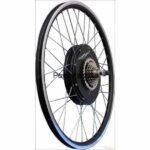
These are all hub motors, integrated into a wheel. They are easy to install on almost any type of bicycle, including small folding bikes, recumbents, trikes and cargo bikes.
The Western alternative: the mid-drive motor
The millions of motors supplied from China have not stopped other manufacturers from rethinking the electric bicycle motor. Brands such as Bosch and Panasonic offer mid-drive motors: instead of sitting in a wheel hub, they occupy a central position near the bottom bracket axle.
The following motor diagram comes from Kalkhoff, which uses a Panasonic unit (see the source page).
The original illustration has not been recovered.
This mid-drive unit has a chain drive sprocket that transfers power to the rear wheel. A torque sensor determines the assistance level by detecting the rider’s effort through the pedals.
Another diagram from Kalkhoff (see the source page) demonstrates how the mid-drive motor works.
The original article also showed a Scott bicycle with a Bosch mid-drive motor, taken from the Scott website.
The original bicycle illustration has not been recovered.
The Bosch motor drives the crankset directly; further details were provided on the BOSCH website. This solution integrates the motor, transmission, sensors and electronic control.
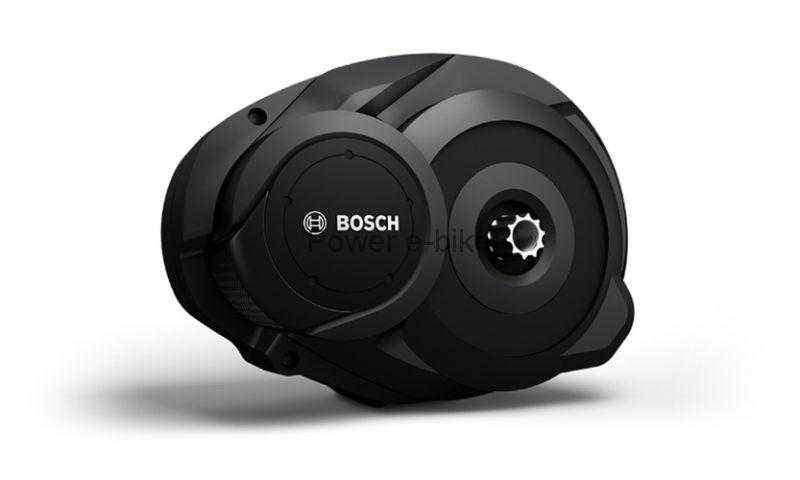
It is an impressive technological solution, and BOSCH already supplies around thirty bicycle brands, including Scott, Cannondale and Merida.
Mid-drive motors are logically fitted to bicycles whose frames were designed from the outset to accommodate the unit. They therefore come on specific, relatively expensive bicycles with higher overall specifications. For a Kalkhoff bicycle, the entry price is around 3000 €.
Some people will consider this consistent with how they wish to use their bicycle. For someone trying an electric bicycle for the first time, it may seem far too expensive. For someone already familiar with electric bicycles and able to assemble the components themselves, that budget offers the means to build a dream bicycle.
China too!
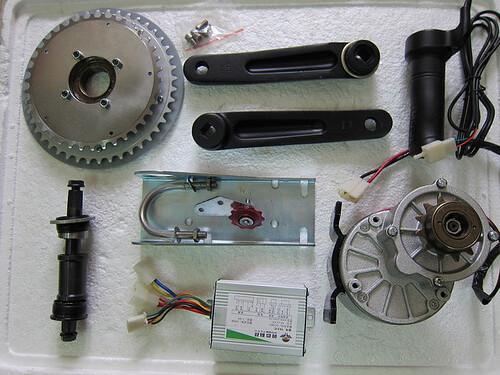
Chinese manufacturers are quick to seize market opportunities. Since 2012, GNGElectric has offered inexpensive mid-drive conversion kits. The kit has gone through several versions—the manufacturer does listen to user feedback—particularly because mechanical stresses quickly damaged the drive belt.
This kit allows the rider to retain part of the original drivetrain, at least the rear wheel and gear system.
A cyclist’s bicycle?
A mid-drive motor drives the crankset. It therefore uses the bicycle’s transmission and gears. Sensor-controlled assistance allows the rider to maintain a constant pedalling cadence regardless of the route profile. For someone who wants exercise and whose pedalling cadence matches the motor speed, it is ideal.
The motor’s position also provides good balance when leaving the road for trails.
Bicycles more expensive than cars!
With a budget between 6000 $ and 13000 $, you can buy one of the bicycles offered by Optibike.
The R11 shown below costs 13900 $ and is rated for 53 km/h and a range of 65 km.
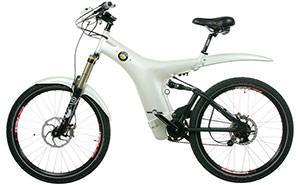
A mid-drive motor can be a piece of mechanical jewellery, and the most expensive bicycles use this solution. Otherwise, the exorbitant price would seem completely unjustified for motors whose specifications and prices are known.
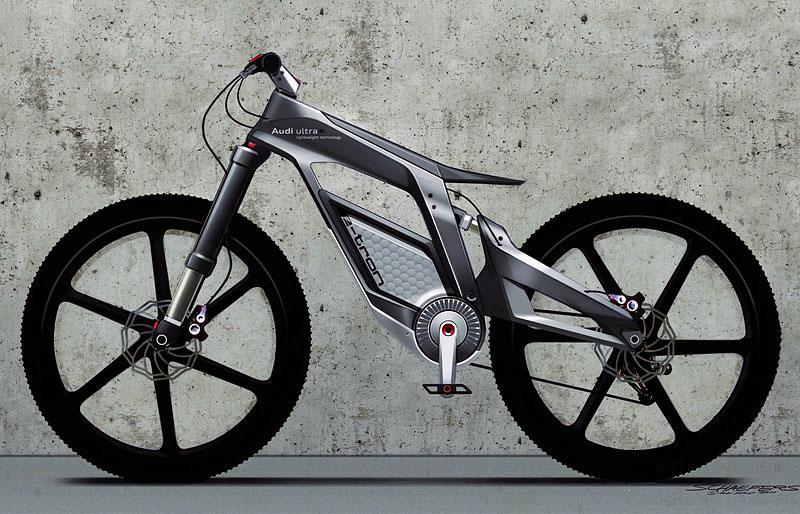
Below is the mid-drive Audi “E-TRON”—apologies for the name. Splendid, but its future price is estimated at 20000 $.
Advantages of a mid-drive motor
- Attractive engineering, technical refinement and a sophisticated assembly, with a frame designed specifically for the motor, except with the GNG kit.
- Use of the bicycle’s integrated transmission and gears, with a constant pedalling cadence regardless of terrain.
- An ideal motor position for the centre of gravity when riding off-road.
Disadvantages
- A high bicycle price.
- A complex motor fitted to a dedicated frame: you cannot retain the bicycle you intended to electrify.
- “Tuning” is impossible, although some motors have a specific sprocket that can be changed to obtain higher gearing.
- The motor and controller are closely integrated, making a different or more powerful controller almost impossible to fit.
- No electric-scooter mode: operation depends on the torque sensor and pedalling.
- Reselling the motor alone on the second-hand market is impossible.
- Carrying out repairs yourself is almost impossible.
- On cheaper systems, reliability could be improved, with chain or belt breakage among the problems.
Conclusion
- An expensive but effective solution intended for Western cyclists who can afford it.
- A monolithic, all-in-one manufacturer solution that is closed to enthusiasts who enjoy specifying, designing and improving their bicycle.