
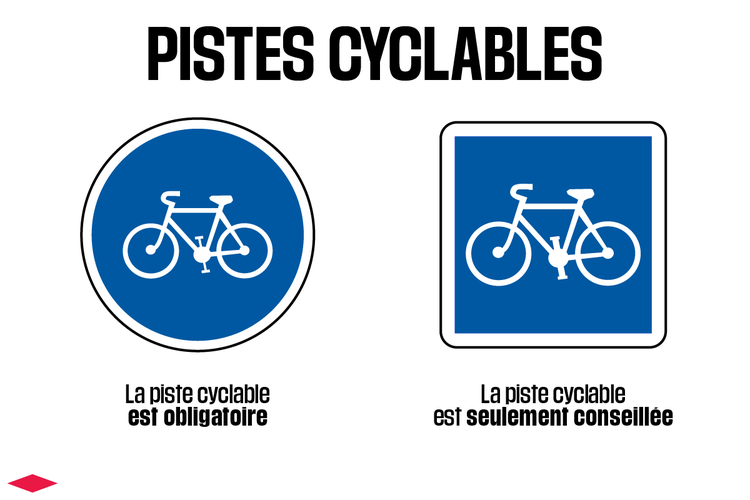
Cycle lanes in France are not all compulsory for cyclists. Signs and the rules applying to the facility distinguish a required route from a recommended one. Check these points before choosing your line.
This guide concerns France. It does not transfer French rules to other countries or determine whether a penalty is justified without the location, signs and circumstances. The existing illustration compares the two French signs.
Read the round B22a or square C113 sign
A round blue B22a sign showing a white bicycle indicates a compulsory cycle track or lane for cycles without a sidecar or trailer. The blue square C113 marks a recommended facility reserved for cycles; that sign alone does not require you to use it. A bicycle painted on the road does not by itself establish a duty to enter.
Article R431-9 provides for compulsory use to be introduced by the traffic authority after the prefect’s opinion. Read all signs, supplementary plates and temporary arrangements. A map extract or cropped photograph may leave out decisive information.
Check direction and other requirements
Before entering, check permitted direction and route continuity. Seeing another cyclist coming towards you does not establish that the track is two-way. Where a road has a track on each side, R431-9 requires users to take the one open on the right in their direction of travel.
A recommended track does not remove traffic lights, priority rules, restrictions or other requirements. Identify junctions, property exits and places where you rejoin traffic. Choosing a comfortable facility does not replace watching other users and adapting your speed.
Distinguish users and spaces
A cycle lane is marked within the road; a cycle track has a distinct carriageway. A greenway shared with pedestrians is a different facility. A pavement does not become a cycle track simply because it looks wide enough.
Two-wheeled mopeds without a sidecar or trailer may be admitted by the competent authority, indicated in particular by an M4d2 plate. This does not admit every scooter. Children under eight may use pavements at walking pace without obstructing pedestrians, unless local rules say otherwise; people pushing a bicycle follow pedestrian rules.
Prepare for a difficult section
If an obstacle, roadworks or a gap interrupts the route, slow down early. Observe temporary signs and prepare a safe alternative. Whether a track is recommended or compulsory does not make a sudden move into traffic safe.
For regular journeys, identify narrow sections, crossings and possible detours in advance. Allow time rather than making a last-second decision. Persistent problems can be reported to the road manager with their precise location; this suggestion does not create a general exemption from traffic rules.
Watch the video in context
The existing video below illustrates a dispute about using a cycle track. It is neither a court decision nor a complete account of the rules at the filmed location.
Assessing an actual situation requires the full signage, direction, any local requirements and the alleged conduct. The shape of one sign visible in a clip cannot establish that every penalty is either valid or unjustified.
Five checks before entering
- Identify the facility and its sign.
- Read supplementary and temporary signs.
- Check permitted direction.
- Identify crossings, obstacles and the exit.
- Respect lights, priority and other users.
Does a square C113 sign require using the track?
No. It marks a recommended facility. Other requirements applying to the route still matter.
Does this allow every motor vehicle onto the track?
No. Access depends on vehicle category and the applicable rules; the exception for certain mopeds does not admit all scooters.
Prepare your journey: checks before buying · bicycle equipment.
Sources and further reading
Official sources checked on 23 November 2026: French Road Code R431-9 and R412-34, road signs and cycling infrastructure documentation. Check local requirements with the competent authority.
- Code de la route — R431-9
- Code de la route — R412-34
- B22a / C113 — France
- Transport.data.gouv.fr — B22a / C113 / M4d2