This archived rear motor kit build story describes moving on from a 250 W e-bike. It retains the contributor’s choices, spending and observations without turning them into a universal method. Prices and delivery times belong to that experience, rather than current offers. Technical notes and a clearly identified French regulatory reference put the reported results in context. The first-person account has been reworded for readability, rather than reproduced as a verbatim quotation.
Why consider a rear motor kit build?
I already had a 250 W e-bike with a front motor and a 36 V battery. A road accident sent it to the scrapyard. After receiving the insurance payout, I wanted a different build. The old bike struggled on substantial climbs; I also reported that it did not exceed 30 km/h.
I mainly used the bike for my daily 20 km journey to work, hoping to spend less on petrol. I was neither an enthusiastic cyclist nor an experienced home mechanic. That personal motivation explains the project. It does not establish net financial savings or the legal category of my previous bicycle.
The kit, the budget and the missing bicycle
I found Power E-Bike by chance. At the time, the equipment looked appealing and I liked being able to choose the battery. A group purchase for the 205rh brought my decision forward. The order arrived a few days later, but I still had no bicycle to fit it to.
I visited shops with a €600–700 budget, a requirement for hydraulic disc brakes, a target below 11 kg and a preference for black and red. I could not find all those features together. I decided to build the bicycle myself and subsequently discovered that this was more complicated than I had expected.
Frame, paint and decoration
I found a bare frame to paint for €99. The finish used six cans of Ferrari-black automotive paint at €10.90 each, five cans of gloss varnish at €10 each and one can of primer at €11. Once the supplies arrived, I found the painting straightforward.
I also ordered GT stickers for €15 simply because I liked their design.
The stickers are described as decoration, rather than proof that the frame was made by that brand. Similarly, painting and assembling a frame does not verify its specifications or establish that it can safely accommodate every possible kit. Those checks are not documented in the account.
Reported components and delivery times
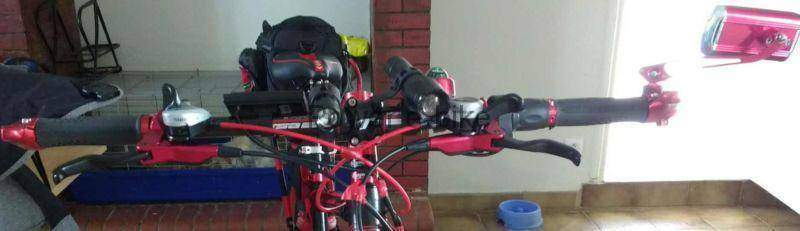
I selected front and rear Shimano Altus derailleurs, a square-taper Shimano crankset for €50, a Suntour front fork for €90 and a bearing for €35. From a Chinese website, roughly €150 bought a carbon handlebar, red ergonomic grips and mirror, comfort saddle, carbon seatpost, luggage rack and stem, lights, pedals, cables, a watch, ties, bottle holder and bell. Everything took a month to arrive.
Another website supplied the hydraulic brakes, discs and magnesium front wheel for €120 together. I added tyres with inner tubes described as puncture-resistant for €30, gear shifters for €20 and a rear bag for €25.
The account does not specify the configuration of the luggage rack and stem.
Battery choice and the finished bicycle
I worried that a battery ordered from the Chinese website might never arrive. I asked Power E-Bike for advice. No seller was named—the account referred to non-compete clauses—but I received help with the choice. I eventually bought a 48 V, 17.5 Ah battery from a French website for €749.
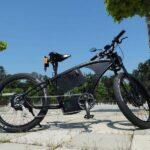
Building the complete bicycle took me about 15 hours. A shop then adjusted the brakes and derailleurs. I reported a final cost of €1,875 and a weight of 35 kg, far above my original target. The project started in late February and finished on 8 May.
The stated total belongs to this account; the component list is not a complete invoice or an independently checked costing.
Speed, voltage and references: what was documented?
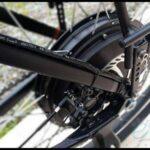
On the first trials I recorded 42 km/h, although I had expected 48–50 km/h with the 280/380 8×8 reference. The table below accompanied the story. An explanation attributed to Power E-Bike mentioned 58 V or even 60 V after charging a nominal 48 V battery; mine displayed 54 V.

The order reference 205rh and the later description 280/380 8×8 are preserved without assuming they identify the same specification. The speed-test procedure, actual power and torque were not documented. Watts describe power, volts voltage, ampere-hours charge capacity and newton-metres torque; these quantities are not interchangeable.
A nominal 48 V label alone cannot substantiate the 58–60 V explanation. The correct full-charge voltage depends on the battery. This passage does not justify a different charger or an increase in operating voltage.
An experience report, without road certification
In France, Service Public describes pedal assistance, a motor of at most 250 W and assistance cutting out at 25 km/h for a VAE.
The speeds reported here therefore establish neither compliance nor permission to use this build on public roads. No certificate is provided in the account. This French reference does not state the requirements in another country.
The contributor was pleased to finish, but provided no durability test or measured financial return. The motor and equipment guide and another kit installation experience provide component context. They do not invite readers to reproduce these speeds or alter a limiting device.