I chose this 9C electric bike kit after three years of commuting with another rear-hub conversion. My round trip totalled about 15 km a day. This account explains why I picked a Nine Continent direct-drive motor, what I liked and which parts of the installation needed extra work.
Why I chose this 9C electric bike kit
I had been happy with my previous home-built bicycle until the freewheel inside my old Bafang motor broke after roughly 6,000 km. Other technical problems led me to replace the arrangement. That failure concerned my particular motor and usage, not every motor made by the brand.
On that old conversion I mainly used the thumb throttle, which I called “moped mode”. I had considered a Bafang BBS mid-drive, but the frequent stops and starts on my urban journey made me prefer a hub motor. Direct drive ultimately suited that personal choice.
Two hours to get running, then further finishing work
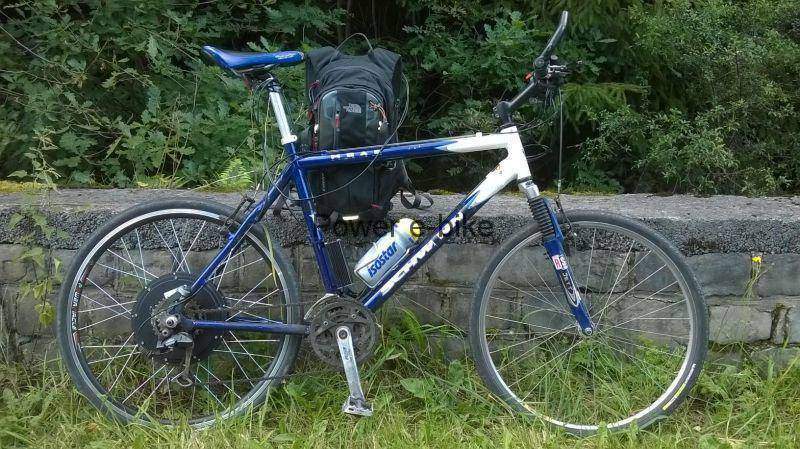
In my case, the wheel fitted into the frame without difficulty. Understanding the cable connections took more thought. The bicycle was running after two hours, but that was not the end of the installation.
I then spent extra time securing the wiring, positioning handlebar accessories and protecting the display. The two hours in this account are therefore neither a guaranteed fitting time nor the complete duration including all finishing work.
The motor, controller and display I used
I chose a direct-drive Nine Continent motor, also called a 9C. It felt powerful and quieter than my previous motor. I liked the apparent quality of the assembly, although I did not have the long-term evidence to call it indestructible.
My controller was specified as 28 A. The original account mentioned batteries from 36 to 60 V and a display configurable for 36, 48 or 60 V. Those statements concern that specific equipment. They do not establish that another battery, controller or display can be substituted.
I also appreciated the purchase price and the quick dispatch from a French company. That describes my experience of the historical purchase, not a current promise about prices or service.
Wiring and rain protection: my reservations
The connectors seemed somewhat fragile and there were many wires. Identifying every connection was not obvious to a beginner, so I referred to the kit documentation. My previous system had grouped cables in sturdy sleeves with marine-style connectors, and I found the new arrangement less convincing in that respect.
I could not find equivalent waterproof protection for the controller, cables and LCD display. I covered the display with transparent plastic cut from a €3 travel wallet and placed the controller and wiring in the rear panniers, under a rain cover when needed.
That improvised arrangement is recorded to describe my installation faithfully. It establishes no waterproof rating and is not a protection procedure to copy. Protection and installation conditions must be appropriate to the actual equipment.
What I noticed with the 7×9 winding
The 9C was bulkier and less discreet than my previous Bafang BPM. To my ears it was also quieter. I expected it to prove more robust, but that was an expectation rather than a long-term test result.
I compared my 7×9-wound 9C with the old Bafang BPM1 described as a 36 V/500 W model, paired in my conversion with a controller described as 750 W and a 44 V battery. Reusing that same battery, I felt a smoother, less abrupt start and estimated a top speed about 10% lower.
These were impressions of two personal installations without a controlled comparison. They are neither a general comparison between brands nor a wiring recommendation. I had not chosen the fastest winding.
My assessment for everyday commuting
I liked the backlit LCD display: speed, a bar indication of instantaneous power, battery voltage, total and trip distance, and assistance level. On my bicycle it also took the place of a separate cycle computer.
At the end of this account I was very satisfied with the whole conversion. Cycling had become important for getting to work, and I found it saved time compared with my car or public transport alternatives. That satisfaction came with practical reservations about the wiring, size and rain protection, which belong in the assessment too.
Guides to understanding the components
- E-bike kit batteries: understand the main parameters
- Conversion kits: choice, installation and compatibility